New page for “Crossing the Pond”

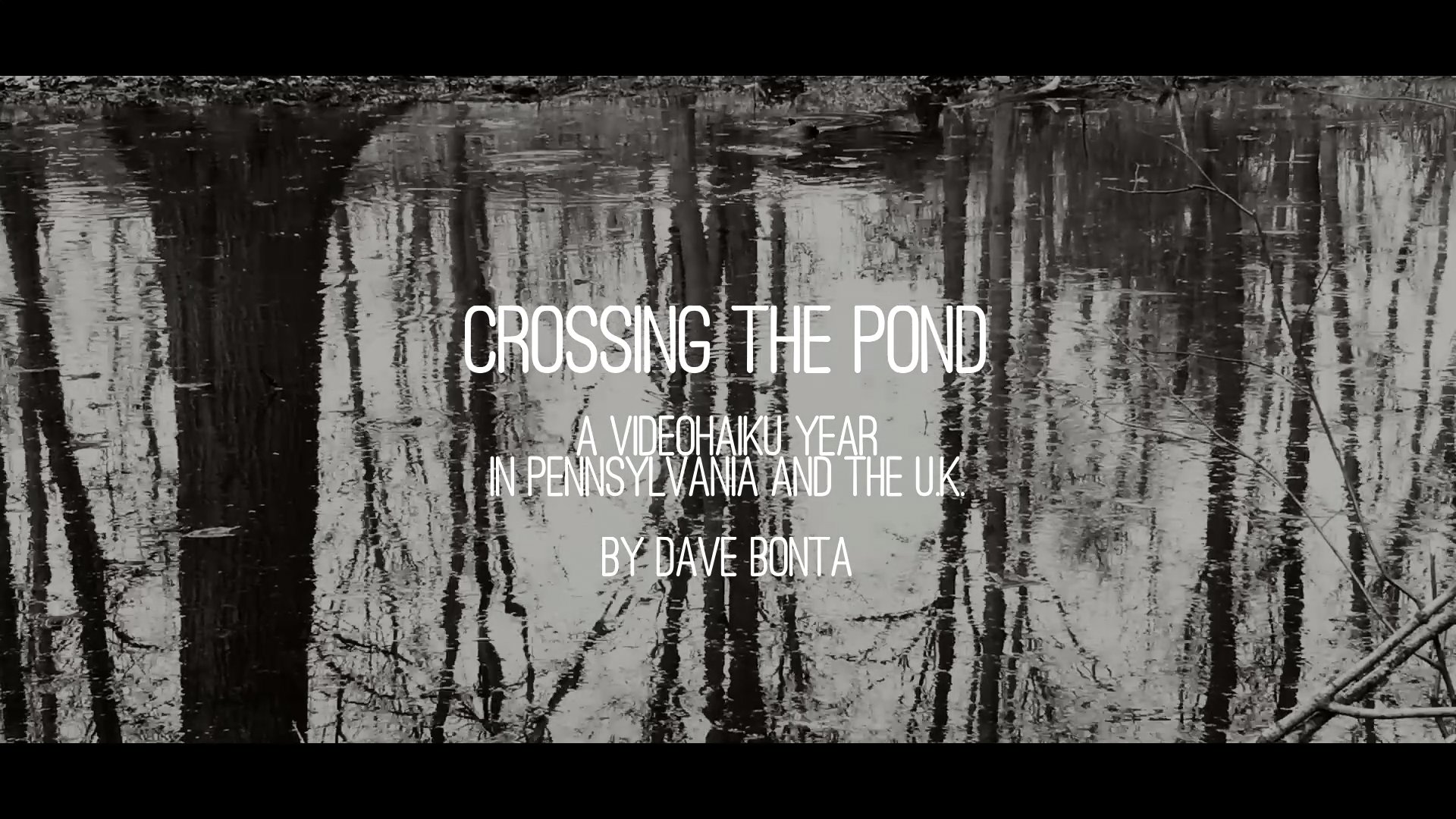
Crossing the Pond title screen

The half-hour film I made with 33 of my videohaiku from 2019 now has its own page here, thanks to the Internet Archive, which unlike my Vimeo Plus account, doesn’t limit the size of uploads, so I’m able to embed it from there. Previously, I could only share the link to Google Drive, which doesn’t have an embedding option. And YouTube requires extra verification measures to upload files of that size, doubtless to try and limit illegal uploads of full-length movies.

This was the first time I’ve used the Internet Archive to host video, but I suspect it won’t be the last. It’s a bit geekier than other video hosting platforms, but the degree of control over metadata is impressive, and the upload and conversion process wasn’t clunky at all. (I don’t know why I thought it might be.) Pretty impressive for a nonprofit. Other appealing features include the total lack of advertising on the site and the ability to attach a variety of Creative Commons licenses. Also, they automatically generate a torrent file — how cool is that?!

Anyway, here’s the new page. I’ve included a transcript of the haiku and links to each of the four seasonal sequences from which it’s derived, which allowed me to remove those pages from the navigation menu and simplify things, so all in all, I think it’s a wrap.

In other videopoetry news, it appears the haibun series that I’m still calling “Pandemic Season” will continue for a while longer. I had thought it might be done in September, but no. After my hiatus making a renku video in October, I’m right back into haibun — so much so that I’m pushing myself to finish up and publish my collection of earlier, more experimental haibun, Failed State, so I will have a clearer picture of where I’m going with this new collection. Funny how that works.

Two haiku in Issue 20.1 of tinywords

scrseenshot from tinywords

I’m pleased to have not one, but two haiku in the currently serializing Issue 20.1 of tinywords, “climate strike…” and “steel band…” Both began life as the texts of videohaiku (here and here); “climate strike” was shortened following a suggestion by the editors.

I’m especially happy to be a part of tinywords‘ 20th anniversary year. As a web publisher myself, I know what’s involved in making it to that milestone — qarrtsiluni lasted all of seven years, and Moving Poems has only been around since 2009. Also, from a tech and usability standpoint, tinywords is one of the (sadly) very few online literary magazines that is doing nearly everything right, in my view. Here’s some of what Kathe L. Palka and Peter Newton wrote in the intro to the issue:

Here we are, nearly twenty years after Dylan Tweney started publishing tiny poems, one per day, like a daily vitamin for wordsmiths.

Dylan comments: “When I started tinywords in November 2000, I was bored, wanted to explore the possibilities of text messaging, and craved more poetry in my daily life. I never thought my little project to fuse these three impulses would grow so big or last so long. And I’m continually amazed by and grateful for the work that Peter and Kathe have done since taking over editorship of this site that I think of as ‘the world’s biggest, tiniest poetry magazine.’”

T I N Y W O R D S has grown over the years and now, as issue 20.1 begins, nearly 1,000 poets have seen their work appear in its pages. Today, almost 7,000 folks subscribe to and read T I N Y W O R D S each day, either through our email subscription list or via Twitter. We also get about 10,000 visitors per month on the website.

A remarkable achievement.

Crossing the Pond and three other videopoems featured at HaikuLife 2020

HaikuLife 2020 banner

The Haiku Foundation’s Jim Kacian, a poet whose own haiku and haiku videos I admire, was kind enough to select four of my videos for their annual online HaikuLife Haiku Film Festival, which debuted this morning as part of International Haiku Poetry Day. Here’s the link.

It would probably seem churlish to offer criticism, so I’ll just say that this festival is clearly designed by someone with an archivist’s mindset, and as the son of an academic reference librarian, I couldn’t be more pleased to have my videos added to the Haiku Foundation’s digital library and uploaded to their own servers. More usability-minded librarians might give them a hard time over the number of clicks it takes to get to the content, however. And as is to be expected with independently hosted videos, they don’t scale down well for people on slow internet connections, so I will have to wait until I get back to London later this year to watch the other films in the festival myself, unless the local public libraries and coffee shops with good WiFi reopen in the meantime.

The main film of mine in the festival is Crossing the Pond, archived here. It’s a selection of 30 of the best videohaiku from the 80 I made last year, pulled together for a program at the REELpoetry festival in Houston back in January. If you’re on crappy internet, it’s probably easier to watch it on Google Drive (it was too big for my Vimeo account). Here are the other three links, accompanied by embeds of my own uploads to Vimeo:

Pandemic Time

Sea Levels

Self-Quarantine

Do check out the other videos in the festival if you can.

I’m not sure anyone has referred to me as an auteur before. I am feeling an inexplicable urge to don a beret and smoke Gauloises cigarettes.

“Failed State” in Failed Haiku!

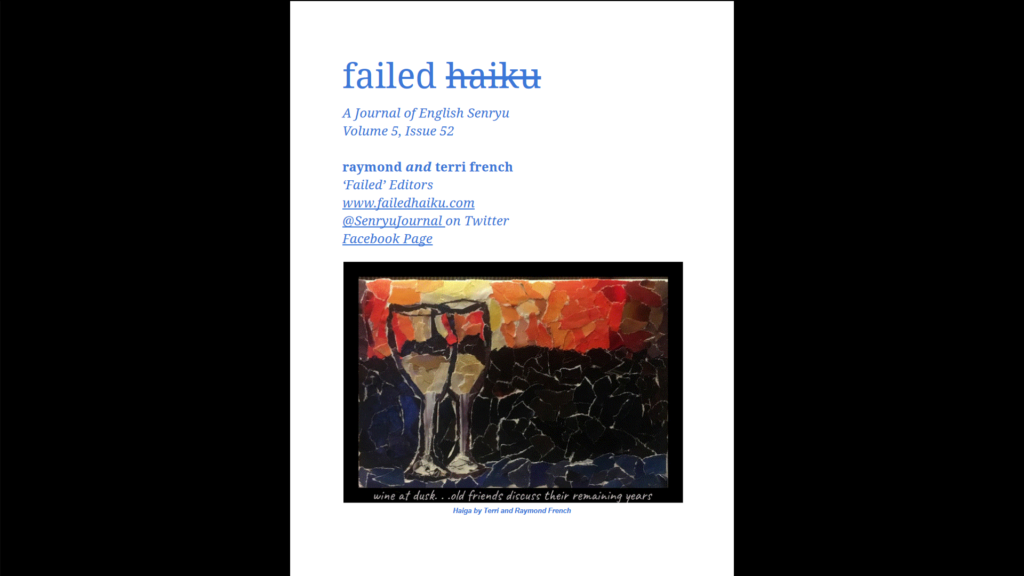
cover of Failed Haiku Issue 52

I was chuffed to place two pieces in a special haibun issue of Failed Haiku, a journal otherwise specializing in senryu — humorous or satirical haiku. Guest editors Terri and Raymond French chose “School of Quietude” as well as the title haibun from my still tragically unpublished manuscript Failed State. (Which these days is feeling more prophetic than ever, I’m sorry to say.) Here’s a direct link to the issue [PDF]. My stuff is on pp. 40-41. The whole issue looks terrific.

I aspire to be a haiku poet, but most of the time I do feel as if I fail at it… in a kind of senryu direction, if I’m lucky: just a bit too unsubtle, a bit too arch. So while this was my first submission to Failed Haiku, I’m sure it won’t be my last.

One of the cool things about the journal is they don’t give a damn whether a piece has appeared anywhere else before, and they can’t be bothered to mention it if so. But I do feel compelled to point out that a different version of the closing haiku in “Failed State” appeared as part of a multi-author haiku-year-in-review broadside from Broadsided Press a few years ago. All the other haiku are new to the interwebs. I seem to recall I shared the prose portion of “School of Quietude” on social media (Instagram?) a year or two ago.

Two haiku in The Heron’s Nest and one in Frogpond

Once in a while I summon the motivation to submit poems rather than just self-publish, and so once in a while I place poems in journals. Funny how that works. The latest success: two haiku in the March issue (Vol. XXII, No. 1) of The Heron’s Nest, an online quarterly edited by the excellent modern haiku poet John Stevenson. They’re both on Page 6. As in most haiku publications, I’m identified only by name and location (which is actually one of the things I really like about haiku culture; I hate how much mainstream poetry orgs focus on personality). Although I gave Plummer’s Hollow as my location, in fact both haiku were written in the UK.

I should also have a haiku in the latest issue (43.1) of Frogpond, the journal of the Haiku Society of America, but since they don’t send out contributor copies and I’m not a member, I’m not entirely sure. Anyway, here’s the haiku they accepted last September:

bare hand
so lovely and cool
harvesting leeks

A memory from childhood. This was actually the second time they’ve published me, but the first was decades ago before I knew much of anything about haiku so it doesn’t count.

Videohaiku feature at Atticus Review + REELpoetry festival gig

Some of my videohaiku, along with an artist’s statement, comprise the latest biweekly feature in the Mixed Media section of Atticus Review: Five Trains / Sea Levels. I’m honored to appear in one of the web’s two or three best homes for videopoetry in English, edited by Matt Mullins, himself a stand-out practitioner of the craft. I’d been reluctant to submit since I know Matt pretty well—I didn’t want to either presume on our friendship, or put him in the awkward spot of having to say no. (I’m told that’s not the way most poets operate, but whatever. Ambition is poison.) But when Matt solicited work, I sure wasn’t going to refuse!

That was several months ago; they have a long queue. Fortunately, my turn came up just in time to promote a program I’m giving as part of the 2020 REELpoetry festival in Houston, which takes place on the weekend of January 24-26. On Sunday, in lieu of a reading I’ll be showing a bunch of my videohaiku, and expanding on some of the thoughts in the Atticus Review essay.

The REELpoetry folks also have me giving the keynote address (gulp!) on Saturday, and I’ll be helping to kick things off on Friday night with a screening called Poesía sin fronteras / Poetry Without Borders focusing on Latin American poetry films, especially those that grew out of the online “Poetry from the Other Americas” group translation project back in 2015-16. Here’s a trailer:

Watch on Vimeo

I’m also on the five-judge panel, and I can tell you that the competition films range all the way from great to spectacular. So why not spend a weekend watching poetry films in Houston, Texas? I’ll be the guy with the big, dark circles under his eyes from weeks of sleep deprivation.

Failing up: More texts from Failed State make their way into the world

Oops, I’ve forgotten about this website again! I apologize to both of my subscribers.

To be honest, I think my major creative accomplishment of the summer has been learning how to make no-knead, whole grain sourdough bread that is not at all brick-like. But since this is a writer’s blog, I do feel obliged to periodically make note of my publications and other similar accomplishments. Why this is important, I’m not entirely sure (unlike with bread baking, where the rewards are obvious and life-sustaining). So. Um, let’s see. I had a haiku appear in an actual print publication called hedgerow, their spring issue, which turned out to be a rather nice anthology, including some genuinely fine English-language haiku that I was pleased to share space with. The haiku of mine that the editor chose happens to be the one that closes my manuscript Failed State:

fresh snow
the child fills the trailer
of her toy truck

Another couple of haiku appeared online in NOON: journal of the short poem, both in Issue 15 (pp. 34-35 if you’re in a hurry). Again, good company, and yes, both haiku are also from Failed State, written this spring as replacements for earlier, weaker haiku. I was especially pleased with the second one—

above the mall
the rest of the mountain’s
unrest

—which caps a haibun titled “Economic Growth”. (Environmentalist friends from the Altoona area may recognize the reference to the ill-advised Logan Town Centre, which despite its name ignored the many serviceable brownfields areas in the actual town center to take advantage of a ridiculous tax break and carve out a steep, seep area on the side of Brush Mountain. Which hasn’t actually collapsed onto Barnes & Noble and Bed Bath & Beyond quite yet, but a big scary crack has opened up in the slope just above.)

Also worth mentioning is a haiku I wrote for a senryu contest sponsored by a publication called Sonic Boom. It’s true that I tend to turn my nose up at contests, but they can be a great spur to creativity, and such was the case this time, as it not only yielded another replacement for a haiku in Failed State, but it was also accepted for publication since it landed on both judges’ shortlists, apparently. You can find it here (PDF) on page 22. A memory from childhood.

Also, Marie Craven’s videopoem based on some of my erasure haibun appeared in Rochford Street Review, Lori Ersolmaz’s Triptych filmpoem from Failed State was screened at the Oaxaca Filmfest, and In West Virginia by Pamela Falkenberg and Jack Cochran, based on my haibun of the same title, has appeared in six festivals, including the Buffalo International Film Festival, the Lisbon Film Rendezvous, the Ó Bhéal International Poetry-Film Competition, and the Green Screen Environmental Film Festival in Trinidad and Tobago.

New videopoetry collection: Summer in the UK

I’ve just completed Summer in the UK, my third online anthology of videohaiku. Go watch! Or read on for a little bit of background.

Much as I love my Pennsylvania mountaintop, I’m not as fond of our humid and increasingly hot summers; the cooler and drier maritime climate of the UK, where my partner lives, is far more to my liking. Regardless, summer is my least favorite season, and I often find it difficult to get in the mood for creative work. For most of July I fell off the videopoetry wagon altogether. But with a rush of catch-up videopoeming and a generous definition of summer (early June to the autumn equinox), I think I now have just enough to make a satisfying collection of haiku videos, if not quite as coherent a sequence as I put together for winter or spring. The high point, I think, is a nine-verse renku (linked verse) sequence called “Sea Levels” based on a low-tide visit to the submerged forest off the Welsh coast at Borth. Other locations in the collection include Aberystwyth, Hebden Bridge, Brill in Buckinghamshire, and various places in London, including Kew Gardens and the British Museum. To preserve a sense of seasonal progression, the videos are presented in the order in which the footage was shot rather than the order of composition.

As before, I’ve given the collection its own permanent page here (linked in the drop-down menu under Videopoetry if you’re viewing this on a proper computer), in addition to a showcase on Vimeo and a playlist on YouTube. The individual videos have also been shared on my Instagram and Twitter accounts (but not Facebook, because I have no truck with that hell site). If anyone would like to share this collection, first of all, thank you! And I think that YouTube will actually give you embed code. I’m happy to share the Vimeo embed code on request. Or of course you could simply share the link to my page.

Inclusion in Haibun Today

Haibun Today banner featuring an ornamental carp

I’m pleased to have a piece in the June 2019 issue of the online journal Haibun Today, selected by Melissa Allen—the first I’ve appeared in HT. It’s based on an incident that happened 15 years ago. Which makes me think I really ought to be a bit more assiduous in editing my old drafts for publication… Anyway, go read “At the Museum” (and click through to the rest of the issue).

A new videopoetry collection: Pennsylvania Spring

Spring may not quite be over yet in Pennsylvania, but it is for me, since I’ve just made my annual eastern migration across the Atlantic to spend the summer and much of the fall with my partner Rachel in the UK. And I’d accumulated 24 spring-themed videohaiku—two more videos than in Winter Trees—so it was time to see whether they worked as a sequence, and I’ve decided that they do. Voilà: Pennsylvania Spring.

As I noted on Via Negativa just now, all but one of the videos was shot on an iPhone without any advance planning, just capturing things of visual interest and letting them prompt haiku a day or more later. The exception, “coal country spring”, uses old home movie footage that came to me in a similar serendipitous fashion: via @HomeMoviesBot on Twitter. As with Winter Trees, I feel that these are best experienced as they unfold, scroll-like, in the video series (which Vimeo now calls a showcase—previously album—and YouTube calls a playlist), in part because the visuals and audio are meant to add an extra dimension to the haiku, as with any videopoem. I am composing as much with video editing software as with the pen, and some of the haiku fall a little flat on the page. But I do include a transcription for the visually impaired. Go read/watch.