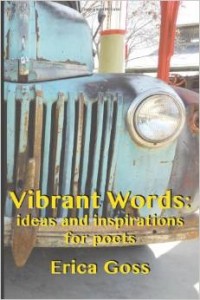
My words in “Vibrant Words” and “Words/No Words”

Vibrant Words coverTo say that I don’t actively pursue publishing opportunities would be an understatement. Nevertheless, from time to time my writing does find its way into various sorts of publications. It’s especially satisfying when those publications are as fun, off-beat and well thought-out as the two collections I’d like to mention today.

The first, Vibrant Words: Ideas and Inspirations for Poets (PushPen Press, 2014) is a collection of poetry writing prompts edited and mostly authored by Erica Goss, a terrific poet and the current Poet Laureate of Los Gatos, California. I’m one of eight other contributors besides Goss, and I must say my tongue-in-cheek piece “Delusions of an Erasure Poet: The Shadow Text” seems almost laughably unhelpful compared with most of the other prompts, but perhaps Erica wanted it in there for comic relief. It’s paired with one of my Pepys erasures, following the pattern of the other chapters where a brief exercise is generally accompanied by an example or two for inspiration.

I wish I had had a book like this 30 years ago, when I was beginning to get serious about writing. The prompts are wide-ranging and the examples (many by Goss herself) powerful but at the same time approachable, by which I guess I mean they don’t bristle with dense syntax, obscure allusions, or other trappings of “difficult” poetry. One thinks “Wow!” but also, “Hey, I can do that.” The prompts include “Parking lots as inspiration,” “Something about the birds” and “Stalked by Walt Whitman,” as well as more standard chapters on strong first and last lines, political poetry, ekphrasis, writing in various forms, and so forth. Throughout, the tone is genial and conversational, and Goss includes a generous list of books for further reading. I would recommend it without hesitation to poets at any level, and am tickled to be in it.

Words/No Words cover artThe other recent publication in which one of my poems is included takes the physical form of a cassette tape. No, I’m not joking — along with the growing interest in vinyl records, apparently the kids these days are also getting into cassettes. Yay, analog media! (says the guy who never would’ve had any of these opportunities without the web).

Fortunately, I am enough of a fossil never to have abandoned cassette tapes in the first place. Poverty has its virtues. The entire CD revolution passed me by, and a boombox still occupies pride of place in my living room. So when the musician/composer Marc Neys, AKA Swoon, handed me a copy of Words/No Words (Already Dead Tapes, 2014) this past July while I was visiting him in Belgium, I knew I’d be able to play it as soon as I got home. And so I did. (I hasten to add that it’s also available as a digital download, a code for which is included in the cassette.)

The title is a literal description of the contents. Pieces with audiopoetry alternate with pure instrumentals (if that’s the right term for music created electronically). I’m hardly an expert in electronic music, which will be seen by the two composers this reminds me of: Swoon’s music is like a mash-up of Edgard Varèse and Nine Inch Nails. Except, of course, when it isn’t. My only criticism of the cassette is that the tiny white letters on black background are difficult for us fossils to read without magnification, and I had completely forgotten what Marc had told me about the contents. So there I am, listening to the cassette for the first time while doing something else, when the fourth track comes on and I hear the familiar tones of Nic Sebastian reading my 12 Simple Songs — the composition that became the soundtrack for the videopoem Marc and Nic surprised me with last year. Nothing like being surprised twice by the same thing!

I’ve listened to the cassette three times so far. The pieces do work together as an album—the whole becomes greater than the sum of its parts—and I like the way the “no words” tracks cleanse the palate between audiopoems. Suffice it to say that, again, I’m very happy to have been included in such an innovative project. The other poets on the cassette are Paul Perry, David Tomaloff, Michael Dickes, Dena Rash Guzman, Erica Goss (yes, it’s true—we’re all members of an online poet mafia), Luisa A. Igloria (another especially delightful surprise on first listening) and Meg Tuite. You can listen to three sample tracks on the publisher’s page.

Twelve Simple Songs still in print

Twelve Simple Songs coverI promoted my poetry-and-photo chapbook Twelve Simple Songs back in February as a Valentine’s Day gift without realizing that the link to order the print version had stopped working sometime last year. I’m selling it at cost, so it doesn’t affect my pocketbook any, but still, the point is to have a pretty artifact for anyone who wants it. So I was pleased to discover that it was only a minor change to the URL; Peecho didn’t delete the publication, much less disappear in the middle of the night or anything.

So my apologies to anyone who has tried to order it only to encounter a broken link. Now once again you can get your choice of hardcover, softcover or magazine formats — or download the other (free) versions from its page here.

Staying alive

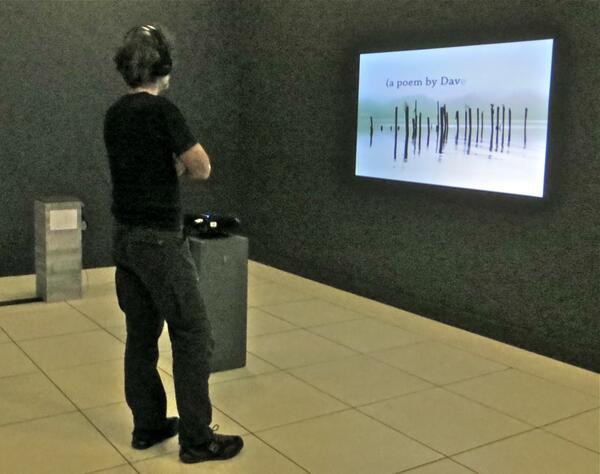
Poems, Places & Soundscapes exhibition
Poems, Places & Soundscapes exhibition – photo by Mark Goodwin

“Publishing: where content goes to die.” So reads a slide from a recent talk by media scholar Ernesto Priego. I thought of this an hour later when I happened to check the website for an exhibition of sound-enhanced poetry and film-poems at the Cube Gallery in Leicester, UK last month, and discovered that even more of my poetry had been included in the film reels than I had thought would be: in addition to my own videopoems Note to Self and The Banjo Apocalypse, Marc Neys’ film Taking the Waters, which includes a prose poem of mine, was also among the videos projected in a continuous loop onto the wall of a gallery for three weeks. And my soundtrack for Shackleton’s Banjo was available at one of the listening stations.

That’s an almost embarrassing level of exposure for a writer who rarely bothers to send anything out for publication. My attitude tends to be why bother, when I can just post stuff to the web? Besides, any time I don’t spend on my own work is devoted to curating other peoples’ work at Moving Poems. But I sometimes wonder how many web visitors watch anything longer than a minute all the way through, or read any poem longer than ten lines.

The quality of attention of gallery- and museum-goers, on the other hand, is in a class by itself, something a skillful curator can turn into a kind of active participation. I gather that the listening stations and film-poem screens at the Poems, Places & Soundscapes exhibition were deliberately juxtaposed in such a manner as to encourage visitors to make connections between unrelated audio and film footage. And that’s pretty wonderful, I think.

But whether it’s YouTube or an art gallery in the UK, non-traditional venues offer as well the always-tantalizing possibility that one’s poems will be heard by people outside the sometimes claustrophobic community of professional poets.

Which is not to say I don’t also value the kind attention of my fellow writers, of course. I was honored this winter when two of the poems from my Bear Medicine series were remixed into videopoems via The Poetry Storehouse, one by Nic Sebastian and the other by Donna Vorreyer — two of my favorite poets. Translating a poem into another language or medium entails a special kind of very close reading, as I know from my own experience, so it was gratifying to realize that writers this good were reading my work in that way.

https://vimeo.com/88640282

*

*

Thanks to Nic, Donna, and Marc, as well as the organizers of the Poems, Places & Soundscapes exhibition—Mark Goodwin of air to hear and Brian Lewis of Longbarrow Press—for helping to keep my web-published content alive.

Review of “Breakdown: Banjo Poems” at Switchback

The online literary magazine Switchback has just published Robbi Nester’s review of Breakdown: Banjo Poems. Nester draws attention to the serious play at work in the collection, as well as to the questions it raises about American history and culture.

Even divorced from these racial overtones, it may be hard to take this instrument seriously. We might even agree with Bonta’s playful admonition that “It is better to hear the rebuke of the wise / than for a man to hear the music of banjos” (“Banjo Proverbs”).

As these poems reveal though, if we take this view of the banjo, we have judged the parody without a clear understanding of its source. By discounting this history, we have further undermined the people the minstrel shows sought to mock.

[…]

Bonta has made a career of revealing the power of other humble implements in his previous work. For example, his book Odes to Tools, published by Phoenician Press in 2010, the poet considers the hammer, plane, and other instruments of labor in a way that will make it impossible for one to regard them with indifference.

Indeed, to read this writer’s poetry, his blogs, and all the other works of his busy hands is to see the world in an entirely new way.

I am not sure I recognize the fabulous writer Nester is describing here, but this review sure makes me want to make his acquaintance! Gosh. (Read the rest.)

Review of “Breakdown: Banjo Poems” at Love During Wartime

Blogger-poet James Collins has just posted a very favorable review of Breakdown: Banjo Poems at his site Love During Wartime. What’s great about the review for me, however, isn’t so much that Collins liked the book (though that was nice), but that he appears to have read it slowly and deeply. It surely helped that he’s Biblically literate as well as conversant with American history and roots music. It was useful to see my own book through the eyes of such a good reader.

I don’t understand authors who claim they never read their reviews. It’s such a great chance to learn what one’s book was really about — because so often, the author is the last to know. Anyway, check it out.