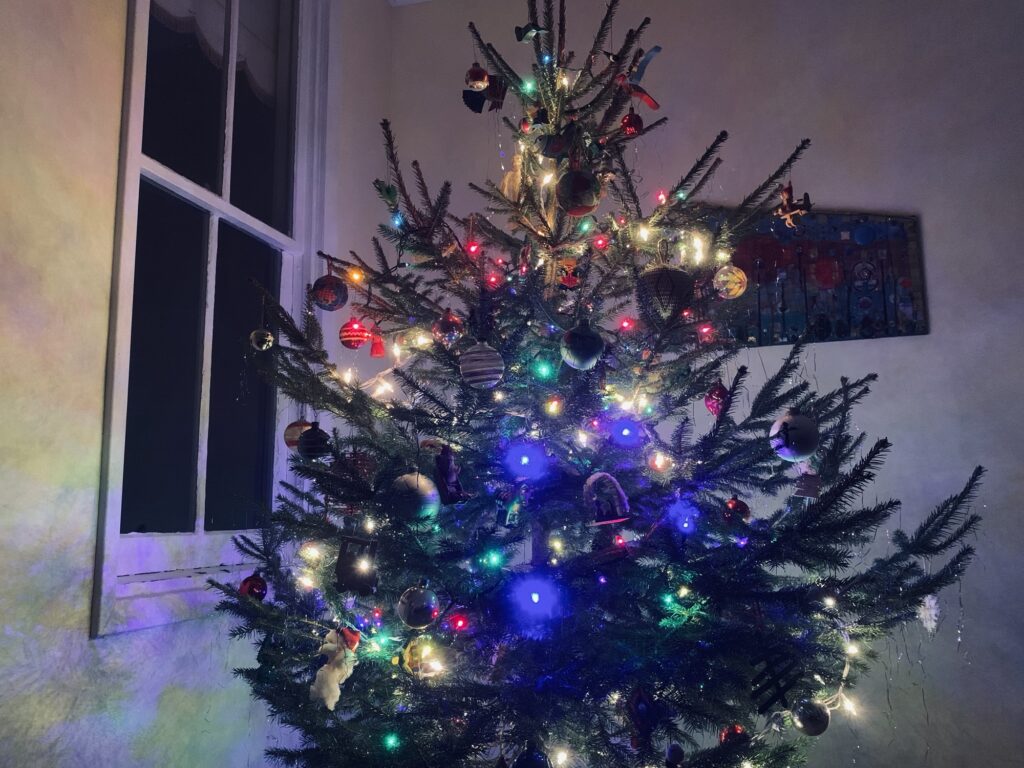
In lieu of a Christmas letter

several generations’ worth of ornaments on one small spruce: a literal family tree

Well deck the halls and call it a holiday! A terrifying new age of the self-repairing machine is nearly upon us and I persist in writing haiku and obscure erasure poems, published mainly on my own blogs. I persist, in other words, in the face of full-on Christian authoritarianism verging on fascism, as a dilettante nature poet and backwoods flaneur. Which sounds unusual unless you’ve ever been to the Appalachians. This is a region that seems to specialize in weirdos of all descriptions, and I am proud to be one of them. I suppose as residents of a national sacrifice area, people develop an especially acute sense of our existential precarity: Rust-Belt rejects, spare parts for broken-down engines. And regardless, here in the United States of America, to live in any place for too long makes you weird. Where’s your ambition?! The Treasury Secretary says that if we can’t afford to live where we live, we can simply move elsewhere. But if there’s one thing fascists hate, it’s anything and anyone who doesn’t fit the mold. To them, a drone that acts as its own mechanic sounds absolutely brilliant, despite or perhaps because of its obvious disincentives for keeping humans around. This is a time for makers everywhere to rebel against the suffocating conformity driven by algorithms and an ecocidal, xenophobic police state. In 2026, I intend to double down on all the sorts of things that machines will never learn to do. In other words, I suppose, I resolve to be as human as humanly possible, and I invite you to join me in what seems like an extremely modest and achievable goal: simply continuing, against all odds, to be odd. Happy Holidays.
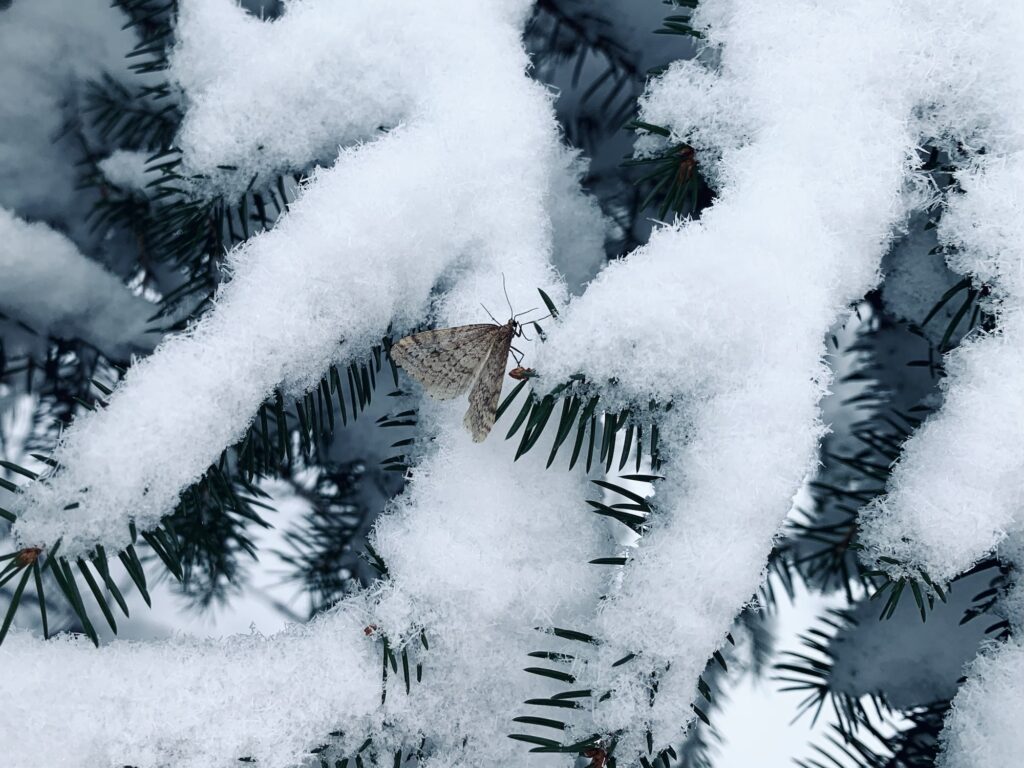
hunter’s moth (Operophtera bruceata)

A certain slant

I used to think that the main role of poetry was to preserve a space for insight and honest language in a society thoroughly steeped in propaganda, much of it as invisible to us as water presumably is to the fish who swim in it. Now I think it’s even more basic than that. With public discourse increasingly taken over by algorithms and large languge models, and public opinion shaped by a corporate death cult convinced that consciousness can somehow be digitized and made immortal, the language arts are becoming a refuge for embodied humanism. Those with no capacity for empathy can still sometimes write great poems, but for poetry to thrive it needs authentic communication between humans, and it has to continually aspire toward the imaginative worlds of others, human and nonhuman alike.

It’s possible that the proliferation of LLM-generated content will actually create more demand for creative writing by humans, but if so, I think it will take time to reach established page-poets who benefit (to the extent that anyone really benefits) from the current system. In the short term, we might see some new admixture of avant-garde and performance poetry emerge on some unexpected platform—think TikTok or Twitch.

Hell, this is could be happening already, for all I know. I do find, from what I read of contemporary poetry in translation—more than half of my reading these days—that the poets of the world are rising to the occasion of our multiple planetary emergencies. The American university system, upon which so many US poets depend, may be in deep trouble, but China has risen, and its millennia-old poetry culture has been thoroughly revitalized by the infusion of Western forms and ideas—pretty much the same thing that happened with previous poetry booms in the Tang and Song. Dickinson alone has been translated into Mandarin by at least 16 different, well-established translators, just since the 1980s. It puts me in mind of the Daodejing, the second most-translated-into-English book after the Bible.

As a comparative literature major, it delights me no end to think that Emily Dickinson could become the Laozi of China. But returning to the topic of this brief mind-fart, time will tell how the Chinese manage the sorcerer’s apprentice that is AI. Contrary to the initial flurry of propaganda, it turns out that DeepSeek produces longer answers that require more energy, so the CCP is playing Russian Roulette with the biosphere as much as anyone else at this point. It will be interesting to see what Chinese poets make of all this, in a society where dissent is suppressed but poetry is produced and consumed obsessively. And no, I don’t think those two facts are unrelated.